
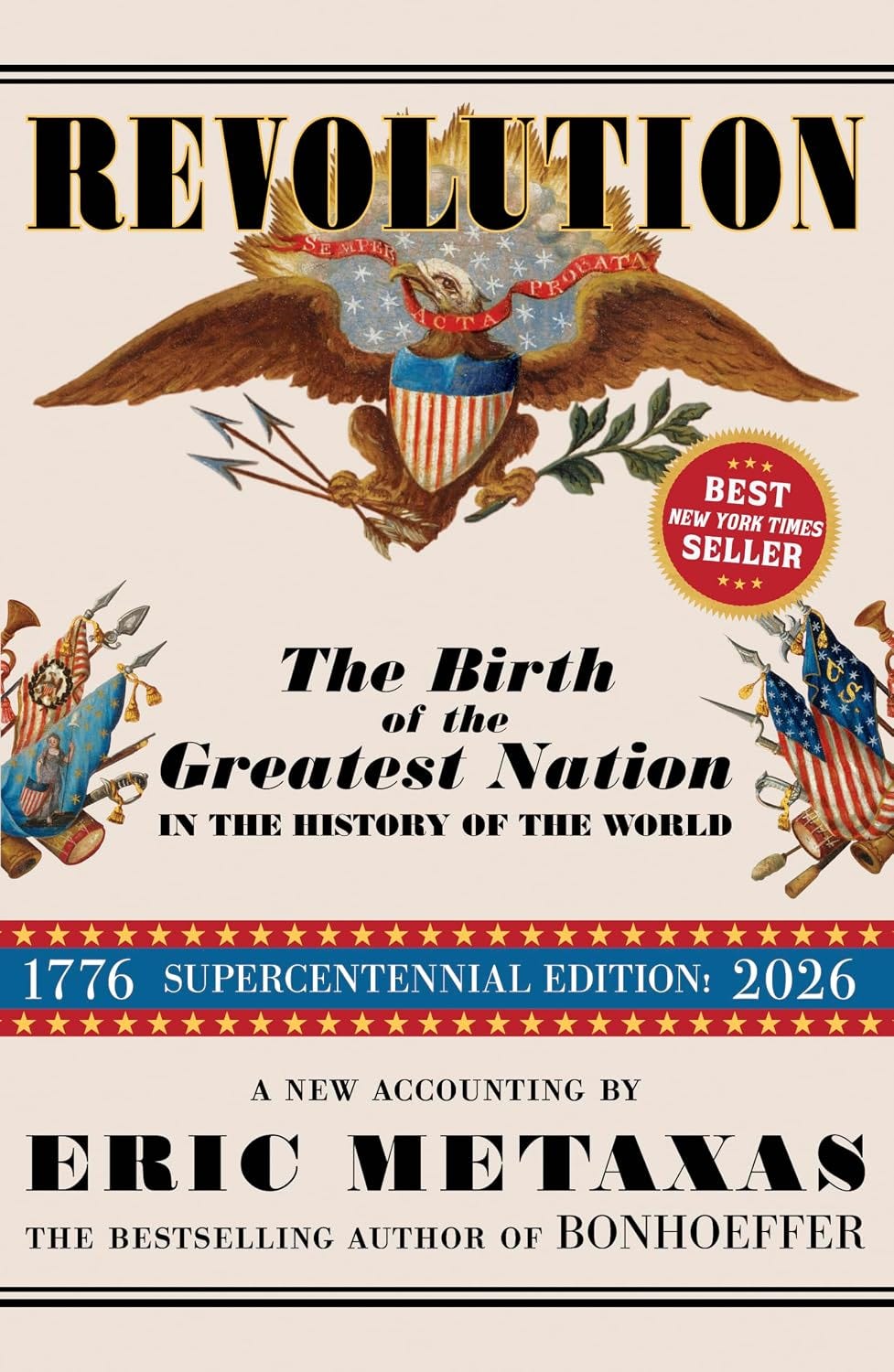
A reading response to Eric Metaxas’s new book, Revolution: The Birth of the Greatest Nation in the History of the World
(used with permission. Originally published on Lorinda’s Substack. See the original post HERE)
The Bonhoeffer biography by Eric Metaxas sat on my nightstand for about a year. The 1.5-inch, 600-page volume intimidated me, despite the fact that I’ve read long books before and I was somewhat familiar with Dietrich Bonhoeffer’s story. Once I finally picked it up, Metaxas’s storytelling skills drew me in, and I devoured it like a historical novel.
So, when Metaxas’s newest book, Revolution: The Birth of the Greatest Nation in the History of the World, arrived, its 600 pages didn’t faze me. I started it on July 5 and completed it about five weeks later, enjoying Metaxas’s quirky humor mixed in with the dramatic, heroic stories of the men and women who founded America.
Summary
This book takes a sweeping view of the American Revolution, opening with the death of George II in 1760. In the first part, Metaxas writes several mini biographies (with copies of portraits) of the cast of characters in this historical drama and traces their struggles with Great Britain. He covers the social and political conflicts that led up to the war and the Declaration of Independence. The latter part focuses on George Washington’s war campaign in addition to some descriptions of the British side and a brief look at battles in the southern colonies.
This title concludes with the Treaty of Paris in 1783, Washington’s relinquishment of his military command, and briefly touches on Washington’s presidency and his laying aside that power as well.
Themes
Unlike other books I’ve read on this topic, Metaxas highlights the cultural divide between the corrupt and decadent British elites and the devout Christian colonists.
This is not to say that all British people were wicked. Edmund Burke and a few others in Parliament sided with the colonists. Furthermore, one must remember that the evangelists Charles and John Wesley lived at this time. Even Rear Admiral Lord Richard Howe and his brother, Sir William Howe, a member of Parliament, sympathized with the Americans, but they led the British forces against the colonies because the king told them to.
Eric Metaxas stated that “One of the themes at the center of our story has to do with the corruption of British elites and the American revulsion toward that corruption” (4). As many historians have pointed out, the post-French and Indian War acts of Parliament imposed on the North American colonies violated the English Constitution, but Metaxas also draws attention to King George III bribing many members of Parliament to do his bidding.
On a cultural level, the British leaders and military men stooped to barbarism and debauchery, whereas the Americans, on the most part, sought to honor God by holding to the higher moral ground.
Earlier this year, my husband and I watched Mel Gibson’s The Patriot (2000) again. The brutality of some of the British soldiers portrayed in that film disturbed me. Early on, when a group of British soldiers seeks to arrest farmer Benjamin Martin’s oldest son, a younger son challenges them. The officer responds by shooting and killing that son. Later, the British lock up an entire village in their church building and set it on fire, burning everyone alive. Historically, such acts of cruelty were not uncommon.
From Metaxas’s primary sources research, I learned that more Americans died as prisoners of war than in battle; the Hessians and some of the British soldiers would bayonet American soldiers who surrendered, and they would rape and pillage villages. The British also encouraged the tribal warriors to torture and scalp settlers.
In contrast, General George Washington demanded that his army treat all prisoners well and live morally as good Christians. John Adams also encouraged the Americans to live this way, saying, “The spirit without knowledge would be little better than brutal rage,” meaning that without following the tenets of the Christian faith, the American Revolution could have devolved into the tyranny and terror that the future French Revolution would become.
The British also scorned the Americans’ faith. Often, soldiers would drill with drum and fife near churches during services, disrupting them with the noise. I had no idea how ungodly the English had become. But then, one of William Wilberforce’s goals, in addition to ending slavery, was to reform English manners in the early 1800s (See the Amazing Grace film or the biography by the same title).
Faith is another major theme woven into the story. Unlike several Christian books I’ve read about American history that seek to prove that the United States began as a Christian nation and pound out the facts, Metaxas allows the record to gently and naturally speak for itself. As he mentioned in a podcast about this book, a historian is dishonest to neglect the Christian faith element of the American Revolution. Numerous times, he records the Continental Congress calling for days of humiliation, prayer, fasting, and thanksgiving. In addition, the individual colonies also set days for people to pray for aid and thank God for miracles, of which there were many.
One miracle was that the 13 colonies, most of which had a predominant Protestant denomination, could unite despite their doctrinal differences. For example, at the First Continental Congress, someone moved to open with prayer. However, the Quakers, Congregationalists, Presbyterians, Baptists, and others didn’t want to hear a prayer from someone of another tradition. Then Samuel Adams stood up and said he wasn’t a bigot (at that time, the term related to those who discriminated against a religious group) and would be open to any godly man’s prayer. A local Episcopalian was invited to pray, and his prayer “…signaled that what united them all was infinitely more important than what theological difference they had” (177).
Style
Metaxas covered many details, including quotations from the period, without bogging down his prose. He maintained a fictional pace with even hints at the end of the chapter that said to an effect, “and guess what happens next!”, making this book a page-turner. His opening reads like a novel in which he tells how George II wakes up, drinks his chocolate, uses the chamber pot, collapses, and dies in bed. But Metaxas tells this with great flair.
I must admit, unlike his other books I’ve read, this one elevates the vocabulary level, uses more literary allusions, and inserts several foreign phrases, particularly in Latin. The author balanced scholarly terms with his characteristic sense of humor, such as using the word “vamoose” and referring to Mr. Magoo. Here’s a sample of Metaxasisms:
[The colonists] must be made to see as decisively as ever that the crude efforts of any number of farmers and hicks could never prevail against His Majesty’s crackerjack professionals (252).
and
The cats and the horses were out of the bags and barns, never to return (303).
Even though he reports many cruel deeds by the British, he doesn’t get graphic except for the story about a man who was bayoneted over 40 times.
Takeaway
Last week, I caught Janet Parshall’s interview of Eric Metaxas on the radio in which she said this book would be an ideal text for students. I have to agree, but for older students, due to the violence depicted. High school homeschoolers would particularly benefit from this book, but I would highly encourage anyone who needs a refresher course, or even an introduction, to the reasons behind the American Revolution and the war itself.
If you don’t want to wade through 600 pages, you can listen to Wallbuilders’s podcast “American’s Founding Was More Miraculous Than You Think,” during which Metaxas tells about his book and explains how much of the information was even new to him as he pursued the original documents and other history books.
Lorinda Newton is a Guest Contributor for Influential Women’s Forum.

